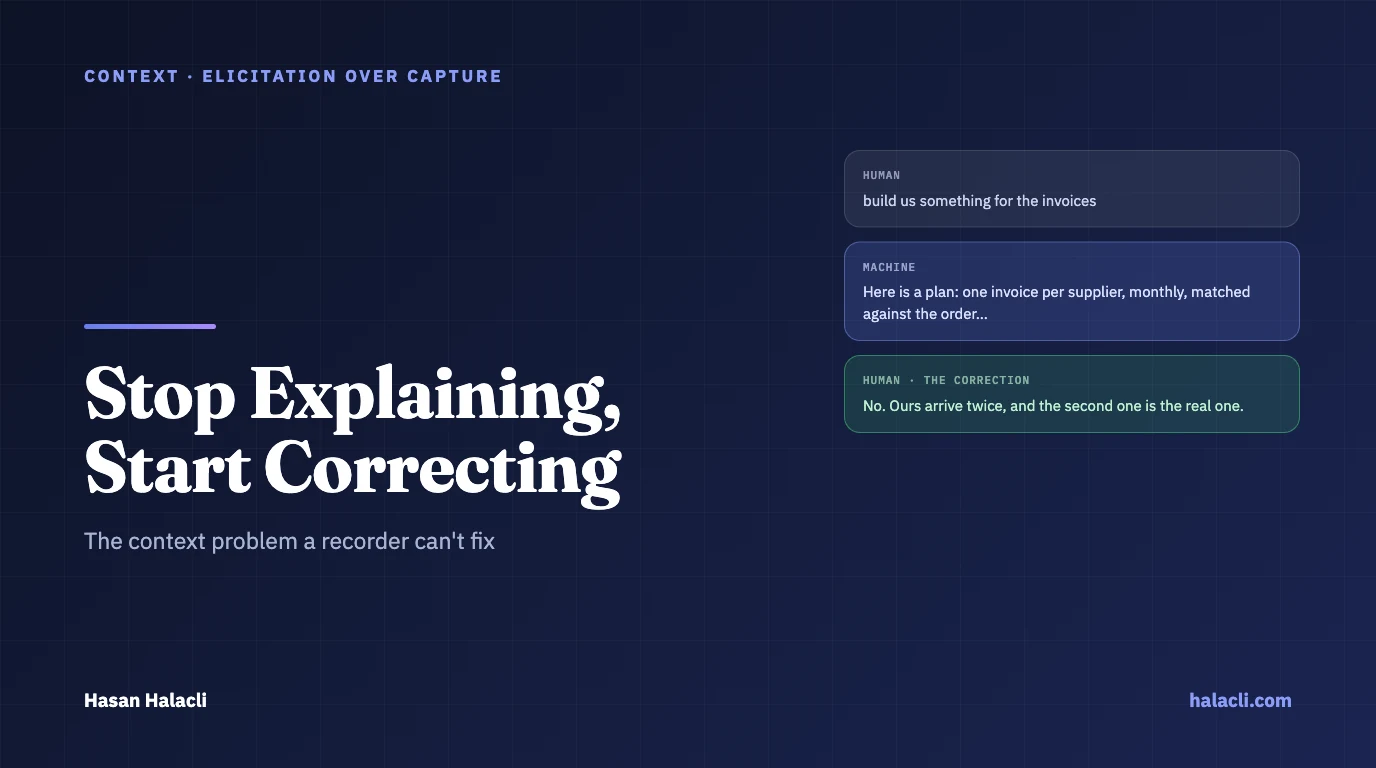
You feel a problem before you can describe it. You lived through the bad quarter, the supplier who sends every invoice twice, the customer nobody wants to name in writing. By the time you type a request into a chat box, most of that is gone, and what is left is a sentence a stranger could not act on.
This is now the binding constraint in working with these systems. Not model capability. The transfer of what a person knows into a machine that has never been in the room.
The industry has an answer, and it is a device. Record everything you see and hear, index it, and the assistant will finally have your context. It is an appealing story, and the evidence from the last two years says it fixes the wrong half of the problem — while in Germany it puts the criminal risk on the one person the story makes a hero: the wearer.
The record-everything devices have already had their run
This is not a prediction. The category shipped, and most of it is gone.
| Device | Where it ended up |
|---|---|
| Limitless Pendant (formerly Rewind) | Acquired by Meta in December 2025. Hardware sales ended, and European users were given until 19 December to export their transcripts before deletion (TechCrunch) |
| Humane AI Pin | Discontinued. HP bought the assets in February 2025 and the servers were switched off two weeks later, bricking the devices (Axios) |
| Bee | Acquired by Amazon in July 2025 (TechCrunch) |
| Microsoft Recall | Still an opt-in preview two years after its first launch, with security researchers repeatedly extracting its database (GeekWire) |
| Meta Ray-Ban glasses | The commercial success of the group — and the one now carrying a regulator's report, below |
Read the first row again, because it is the whole argument in one fact: the flagship record-everything product left Europe rather than comply, and gave its European users a fortnight to take their transcripts with them.
A recorder collects the wrong thing
Suppose the pendant worked perfectly and the legal questions vanished. You would have a complete record of what you did. You would still not have the thing the machine actually needs, which is what you would have objected to.
Objections do not exist until there is something to object to. No recording contains them, because in the meeting nobody said "and note that our invoices arrive twice, and the second one is the real one" — everyone in the room already knew.
Two ways to get context out of a human
One records what happened. The other produces the sentence that was never said out loud.
Worse: more context makes the machine ask fewer questions
There is a finding from May 2026 that ought to end the debate on its own. Researchers tested whether models ask for clarification when a request is ambiguous. The models can spot the ambiguity when you ask them to judge it. In normal use they overwhelmingly answer anyway — and when you hand them retrieved context, they become less likely to ask (Su and Cardie, 2026).
Feed the machine your recorded life and you do not get a better interlocutor. You get one that is more confident it already understands you, and asks less.
The volume story has a second problem. A study across eighteen frontier models found accuracy degrades as input grows, unevenly and in every model tested. In one case a focused prompt of about 300 tokens beat the full 113,000-token version carrying the same answer (Chroma, 2025). On a memory benchmark built from long conversations, commercial assistants dropped roughly 30% in accuracy compared with answering from a clean slate (LongMemEval, ICLR 2025).
Same answer, two prompt sizes
From the Chroma study: a focused extract outperformed the full context that contained it
What actually works: make it wrong on purpose
Here is the pattern, and it inverts the usual advice. Do not try to explain well. Get something concrete in front of yourself and correct it.
You:      build us something for the invoices

Machine:  Plan: one invoice per supplier per month, matched against
          the purchase order, flagged when the totals differ.

You:      No. Ours arrive twice and the second one is the real one.
          Match on the second, keep the first for the audit trail.
Two turns, and the machine now holds a constraint that no recording of your working week would have produced. The reason is not mystical. Judging a draft is a far cheaper mental operation than producing a specification from nothing — the oldest rule in interface design is to let people recognise rather than recall (Nielsen, heuristic six, unchanged since 1994).
Three practical moves follow:
- Make it interview you before it builds. A model that asks six questions first is worth more than one that starts typing code immediately, and since it will not ask on its own, tell it to.
- Keep the artefact, not the recording. A plan a colleague can read holds the decisions. A transcript holds the noise around them.
- Remember decisions, not days. Assistants now carry memory — Claude's became on by default in August 2026, with a per-topic view you can edit (TechCrunch), and ChatGPT keeps both saved memories and derived ones, where deleting the chat does not delete what was derived from it (OpenAI). Keep what was decided and why. Throw away the rest.
The strongest argument against me
Draft-and-correct is not free of cost, and the evidence on that is forty years old and still the best we have. Boehm's team ran seven teams building the same product, some writing a specification first, others prototyping. The prototypers produced about 40% less code for 45% less effort, and their software rated easier to use — but it also rated lower on functionality and robustness, and the specifiers ended with more coherent designs (Boehm, Gray and Seewaldt, 1984).
That is the honest shape of it. Correcting a draft is how you discover what you meant. Writing it down properly is how you make it complete. Use the first to find the requirement and the second to pin it, and do not pretend the first replaces the second.
Why the recorder is a European problem in particular
Everything above is about whether capture works. This part is about whether you are allowed to, and it is the part that will land on the company, not the vendor.
Recording a private conversation is a criminal offence in Germany. Not a data-protection finding — §201 StGB, up to three years, with the attempt punishable and the device confiscable. Every participant must agree. A pendant running quietly through a meeting exposes the person wearing it.
That framing was reinforced this month. On 10 September 2026 the Hamburg data-protection authority published its report on Meta's Ray-Ban glasses: recording people outside a close private circle is generally not permissible, the recording light is only limitedly perceptible and insufficient on its own as notice, and — the line that matters for any company handing these to staff — the wearer is a controller in their own right (HmbBfDI).
Inside a German company there is a second gate. Equipment objectively capable of monitoring staff behaviour requires the works council's agreement under §87(1)(6) BetrVG. A 2024 labour-court decision is often quoted as evidence that AI tools escape this — but the Hamburg court reached that result precisely because the tools ran in employees' own browsers on no company hardware (ArbG Hamburg, 24 BVGa 1/24). Issue a recording device and the reasoning runs the other way.
There is a lawful shape for meeting transcription, and it is instructive: Bavaria's supervisory authority accepts that live transcription can rest on legitimate interest, but without permanently storing the spoken word — an anonymised summary, case by case, with a stated right to object. In other words, the permitted version keeps the decision and discards the recording. Which is exactly what I argued above on purely practical grounds.
My honest read of where this goes: today it looks like a gadget question, and tomorrow it is a compliance question that arrives at the European company deploying it, not at the American company selling it. That asymmetry is worth planning around now.
What I would do on Monday
No hardware required.
- Before any build, make the assistant interview you. Ten questions, answered badly, beat a paragraph written carefully.
- Have it draft the plan, then hunt for the sentence that is wrong. That sentence is your missing context, and you will recognise it instantly.
- Write the decisions into a file the team can read. Not the chat log — the decisions, and why.
- Turn memory on deliberately, and read what it stored. Both major assistants now let you inspect and delete it. Something you cannot inspect is not memory, it is a liability.
- Keep recordings out of the building until someone has answered the works council question in writing.
The Bottom Line: You will never explain your situation as well as you understand it, and that is fine — you were never the right instrument for that job. Your value is that you know instantly when something is wrong. So stop trying to produce the perfect brief, make the machine produce a wrong one, and correct it. The best context you will ever give a model is the sentence you only say when you see it getting something wrong.
Related: Prompting Is Context Engineering covers what to feed a model once you know what matters. This post is about the step before that — getting it out of a human in the first place.