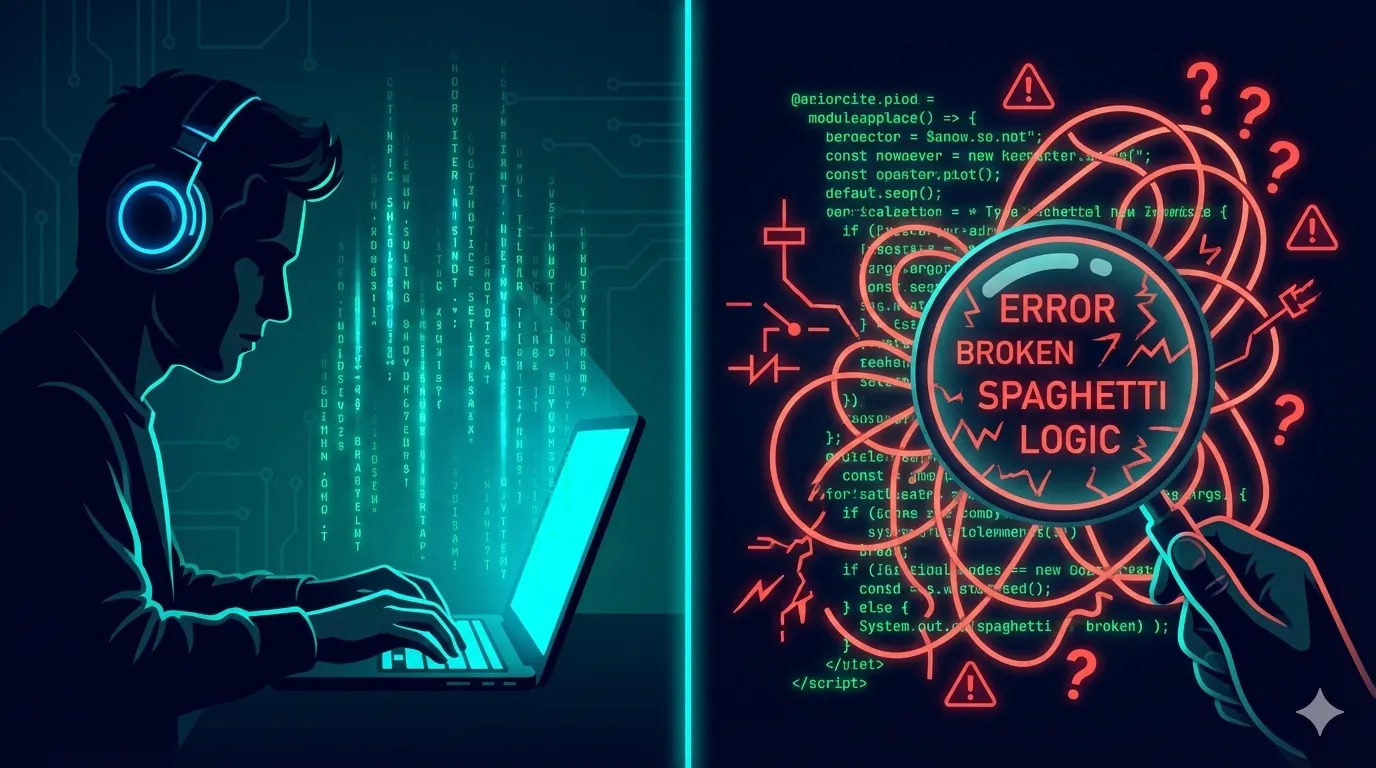
Last week, I sat in a technical interview for a data scientist position. The candidate was confident. He had built a working application in the allotted time. Impressive speed. Then I asked him to explain his code.
He showed me his Claude Code session—the entire conversation history with the AI. He had vibe-coded his way through the challenge. The app ran. But when I dug into the logic, it was fundamentally wrong. When I looked at the deployment setup, the Docker image would have been massive—hundreds of megabytes of unnecessary dependencies. He couldn't explain why he chose certain libraries, couldn't identify the logical flaw, couldn't optimize the bloated build.
He had produced something. He understood nothing.
This is the new reality of hiring in the AI era. And it terrifies me.
The Great Commoditization of Code
Let me be blunt: writing code is no longer a differentiating skill.
With Claude Code, GitHub Copilot, Cursor, and a dozen other AI coding assistants, anyone can produce working code in minutes. A junior developer can vibe-code a REST API, a machine learning pipeline, or a full-stack application faster than ever before. The barrier to "shipping something" has collapsed.
This sounds like progress. In many ways, it is. But it has created a dangerous illusion: that producing code equals understanding code.
The candidate in my interview wasn't lazy or incompetent. He was a product of the new paradigm—trained to prompt, not to think. He could get Claude Code to write anything. He just couldn't tell if it was right.
The Hidden Costs of Vibe Coding
When you deploy AI-generated code without experienced review, you inherit problems that won't surface until production:
Wrong Logic, Working Code
AI can produce code that runs perfectly but does the wrong thing. It passes your tests (which the AI also wrote) but fails in edge cases you never considered. The candidate's code would have processed data incorrectly—not crashing, just silently producing wrong results. The most dangerous bugs are the ones that don't throw errors.
Bloated Deployments
AI doesn't optimize for production. It imports entire libraries when you need one function. It adds dependencies "just in case." The candidate's Dockerfile pulled in packages he never used, frameworks he didn't need, and base images three times larger than necessary. In cloud environments, this bloat translates directly to cost and latency.
Unreadable, Unmaintainable Code
AI-generated code often works but reads like it was written by a committee of strangers—because it was. Variable names are generic, abstractions are inconsistent, and the architecture reflects the fragmented nature of prompt-by-prompt generation. Six months later, no one—including the original author—can understand it.
Security Vulnerabilities
AI suggests patterns it learned from training data, including insecure ones. SQL injection, hardcoded secrets, improper input validation—these slip through when no experienced eye reviews the output. The AI doesn't understand your threat model. It just writes code.
The New Team Structure
If code writing is commoditized, what's valuable? Judgment, experience, and the ability to read critically.
I believe data science and AI teams need to restructure around three distinct roles:
1. Architects and Guides
These are your experienced engineers—people who have deployed systems at scale, debugged production incidents at 3 AM, and learned what not to do through painful experience. They don't write most of the code anymore. Instead, they:
- Define what should be built and how it fits into the larger system
- Know the company's tech stack, security requirements, and deployment constraints
- Guide junior developers on which libraries to use, which patterns to follow
- Catch architectural mistakes before they become technical debt
The architect's job is to know what questions to ask before anyone writes a line of code.
2. Code Auditors and Reviewers
This is the new critical role. Someone must read every line of AI-generated code with skepticism:
- Is the logic actually correct, or just plausible?
- Are there security vulnerabilities?
- Is this readable and maintainable?
- Can this be simplified?
- Will this scale?
Code review has always mattered. In the age of AI, it's existential. You need people who can read code faster than AI can write it—and who know what "good" looks like.
3. Vibe Coders (Supervised)
Yes, you still need people who can prompt AI effectively and produce working code quickly. But they operate under supervision. Their output feeds into the review pipeline. They're valuable for speed, not judgment.
The dangerous mistake is promoting fast vibe coders to unsupervised roles before they've developed the experience to audit their own work.
The New Interview
Our hiring processes haven't caught up. We still ask candidates to build things from scratch, timing them like it's a coding competition. This rewards exactly the wrong skill—speed of production over quality of judgment.
Here's what I've started doing instead:
1. Show Me Your AI Conversation
I want to see how you prompt. Do you give context? Do you iterate? Do you question the AI's suggestions? Or do you accept the first output and move on?
2. Explain This AI-Generated Code
I give candidates code that Claude or Copilot might produce—functional but flawed. Can they identify the issues? Can they explain what each line does? Can they suggest improvements?
3. What's Wrong With This Architecture?
I present a system design that an AI might suggest. Can they spot the scalability problems, the security gaps, the operational nightmares? This tests experience, not production speed.
4. Optimize This Deployment
Here's a bloated Dockerfile, a slow CI/CD pipeline, or an over-provisioned cloud setup. Make it better. This is where real-world experience shows.
The Experience Premium
Here's the irony of the AI coding revolution: experienced engineers are more valuable than ever.
Juniors can now produce code that looks senior-level. But they can't judge it. They can't deploy it properly. They can't debug it when it fails at scale. They can't mentor others on what good looks like.
The companies that will thrive are the ones that understand this. They'll invest in:
- Senior engineers who review and guide, not just produce
- Code audit processes that catch AI-generated mistakes
- Training programs that teach juniors to read critically, not just prompt effectively
- Interview processes that test judgment, not just speed
The companies that will struggle are the ones seduced by the productivity illusion—shipping fast, understanding nothing, and drowning in technical debt they didn't know they were accumulating.
The Bottom Line: Writing code is easy now. Knowing what to write, recognizing when it's wrong, and deploying it properly—that requires experience AI can't fake. The vibe coding trap is thinking you can skip that part. You can't.