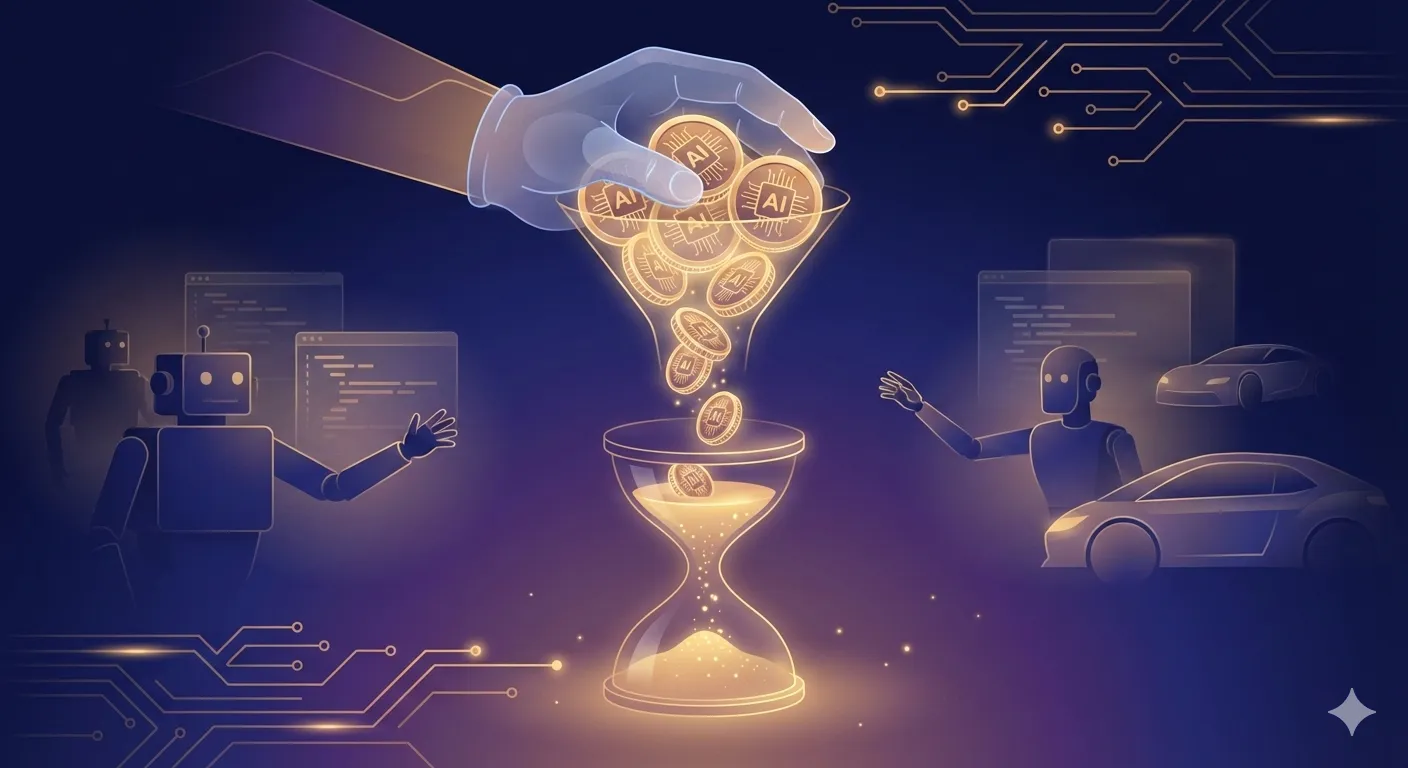
We've lived through the golden age of unlimited software. Netflix doesn't charge per movie. Spotify doesn't meter your minutes. But AI? AI is different. Whether it's Claude Code, GitHub Copilot, Cursor, or any of the emerging AI-assisted development tools—they all share one thing: tokens are limited, and you will run out.
This isn't just a billing model. It's the beginning of a new economy.
The New Billing Reality
The shift is subtle but profound. Traditional SaaS gave us predictable monthly costs for unlimited usage. AI tools have introduced something different: consumption-based pricing where every prompt, every code completion, every conversation burns through a finite resource.
The subscription tiers look generous on paper:
- "Pro: 5 million tokens/month"
- "Team: Unlimited* (*fair use policy applies)"
- "Enterprise: Custom token allocation"
Then you start actually working.
The Multi-Project Problem
Here's the reality no pricing page warns you about: professional developers don't work on one thing.
On any given week, I'm context-switching between:
- Primary job: Enterprise ML pipelines, code reviews, debugging production issues
- Side projects: Personal tools, open-source contributions, learning new frameworks
- Experimentation: Testing new AI capabilities, prototyping ideas
Each context switch means new conversations. Each new conversation means re-establishing context. Each re-establishment burns tokens explaining what you're working on, what the codebase looks like, what you've already tried.
A single deep debugging session can consume what you thought was a week's worth of tokens in an afternoon.
Token Management: The Skill Nobody Taught You
We've had to learn a new discipline: token economics.
- Do I start a fresh conversation or try to continue this overloaded one?
- Should I paste this entire file or summarize it?
- Is this question worth 10,000 tokens, or can I figure it out myself?
This isn't how we should be thinking about tools that promise to augment our productivity. Yet here we are, rationing our AI usage like it's a scarce commodity.
Because it is.
Beyond Developers: The Robot Economy
Here's where it gets bigger than coding tools.
We're on the edge of a world filled with AI agents—not just chatbots, but physical and digital entities that act autonomously:
- Home robots that clean, organize, and manage your household
- Autonomous vehicles navigating complex environments
- Personal AI assistants managing your calendar, emails, and tasks
- Industrial agents monitoring systems, optimizing processes, making decisions
Every one of these needs intelligence. And intelligence costs tokens.
When your home robot encounters an unfamiliar object, it doesn't just use pre-programmed logic. It queries a vision model. It searches the web. It reasons about context. Each of these operations burns tokens.
The robot vacuuming your floor might need:
- Vision tokens: Identifying obstacles, mapping rooms
- Reasoning tokens: Deciding optimal cleaning paths
- Web search tokens: Looking up how to handle a new surface type
- Communication tokens: Reporting status, asking for clarification
Multiply this across every AI-powered device in your life. Your home won't just have an electricity bill—it will have a token bill.
Tokens as Universal Currency
Step back and look at what's emerging:
- API credits that companies buy in bulk and allocate to teams
- Usage dashboards tracking who consumed what
- Token budgets per project, per sprint, per developer
- Rollover policies (or lack thereof) creating end-of-month anxiety
Sound familiar? It should. We're reinventing payroll and expense management, but for AI.
The logical next steps aren't hard to imagine:
| Today | Tomorrow |
|---|---|
| Token allocations per user | Token transfers between users |
| Company-purchased API credits | Token marketplaces across organizations |
| Subscription tiers | Pay-per-task micro-transactions |
| Platform-locked credits | Portable tokens across any AI provider |
| "Unlimited" with throttling | Token compensation as part of salary |
The infrastructure for all of this exists. Blockchain-based token systems have been doing exactly this for years. The AI providers just haven't connected the pipes yet.
The Scarcity Paradox
Here's the uncomfortable truth: the tools that promise to multiply our productivity are gated by artificial scarcity.
The same AI that can help me refactor an entire codebase in minutes now makes me pause and calculate whether I can afford to ask it.
This creates perverse incentives:
- Using AI for trivial tasks (where it saves minutes) instead of complex ones (where it saves hours)
- Hoarding tokens for "emergencies" instead of integrating AI into daily workflow
- Reverting to manual work because "I don't want to waste tokens on this"
And as AI agents become ubiquitous, this scarcity scales:
- Your robot hesitates before making a web search
- Your autonomous car limits its reasoning cycles
- Your assistant skips context because it's "too expensive"
We're building a world where intelligence is rationed.
What Needs to Change
The current model is transitional. As competition increases and infrastructure scales, I expect:
- True unlimited tiers: For professionals who generate more value than they consume
- Smarter context management: Tools that reduce token waste through better memory
- Project-based pricing: Pay for outcomes, not inputs
- Portable tokens: Use your allocation across any compatible tool or agent
- Token exchanges: Trade surplus capacity, gift to others, cash out
Until then, we're all learning to be token economists—budgeting, forecasting, and occasionally running on empty.
The Bottom Line: Tokens are becoming the universal currency of intelligence. Today we ration them for code. Tomorrow we'll budget them for our robots, our cars, our homes. The question isn't whether this economy will mature—it's whether you're ready to live in a world where thinking has a price.