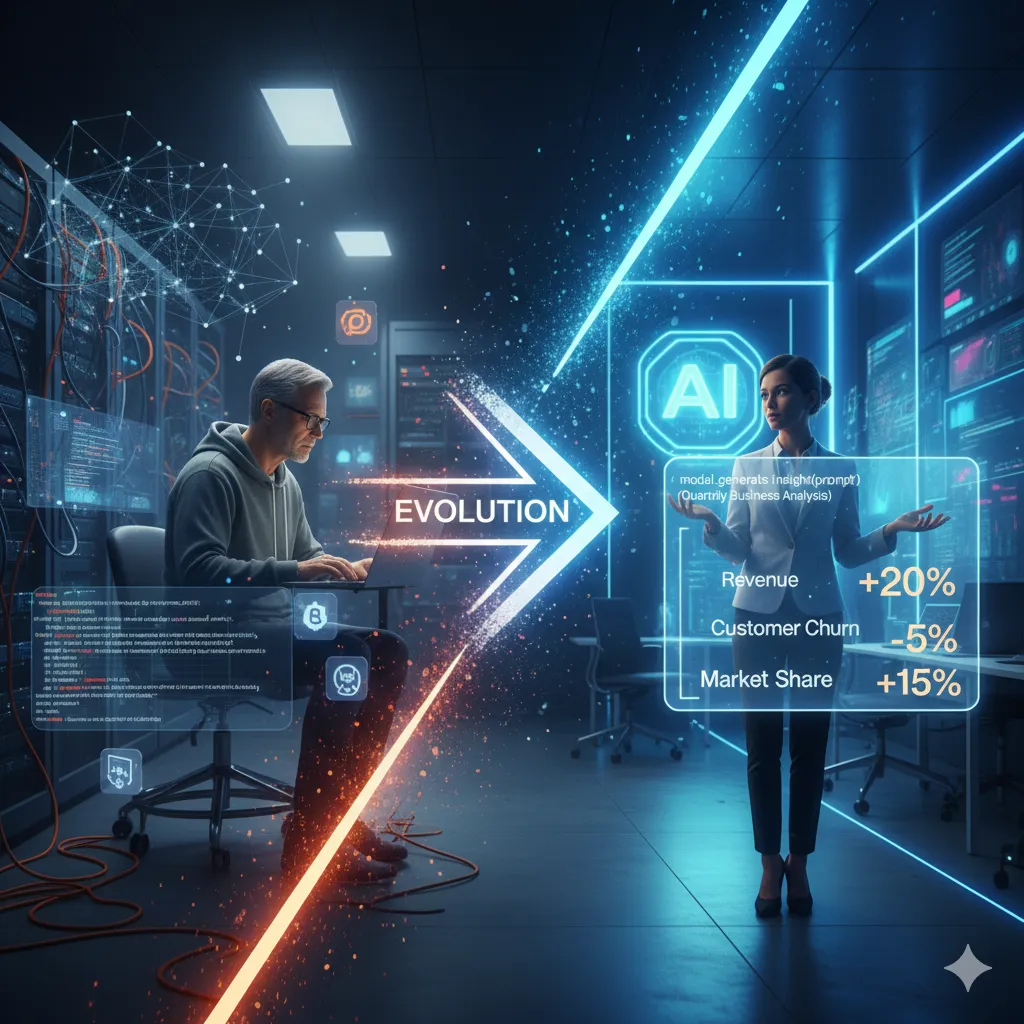
I've witnessed the rapid evolution of our field as a Data Science Lead. The rise of AutoML and Generative AI (GenAI) isn't just changing tools; it's fundamentally reshaping the very definition of a data scientist. This isn't a threat to jobs, but rather an unprecedented opportunity to elevate our collective impact, transforming data scientists from technical implementers into strategic problem-solvers, ethical guardians, and expert communicators.
The future data science team will be characterized less by deep coding prowess and more by their ability to leverage AI tools, understand complex business contexts, ensure responsible AI, and translate intricate insights into actionable strategies.
The API-ification of the ML Lifecycle: Data Scientists as Orchestrators
The most profound observation today is the acceleration of the commoditization of machine learning. The data scientist's traditional toolkit—the meticulous process of cleaning data, engineering features, and training bespoke models—is now being abstracted away by powerful foundation models accessed via simple APIs.
The modern data scientist is increasingly an LLM API caller, eliminating much of the traditional "toil":
No Model Training: Why spend weeks training a bespoke classification model when a well-engineered prompt against a high-quality LLM API (like GPT-4 or Claude) yields "good enough" results in minutes?
No Feature Engineering: LLMs, especially in conjunction with RAG systems, can infer and utilize relevant context features from unstructured data themselves.
No Data Prep/Labeling: Even the most painful phases—data preparation and labeling—are being automated. LLMs are used to rapidly annotate, summarize, and clean datasets, reducing the manual effort to an audit function.
This complete abstraction of the core technical stack, from data preparation to pre- and post-processing, points to a concentrated future: The esoteric knowledge required for foundational model training will increasingly reside within a few specialized organizations (like OpenAI, Google DeepMind, and Anthropic). They will likely be the ones training the "next-level" LLMs, potentially using the current generation of LLMs as specialized assistants in the process.
However, this doesn't diminish the value of the augmented data scientist; it simply changes their focus.
The "New" Core Competencies: What AI Can't Do
This technological abstraction forces us to pivot to the uniquely human, high-leverage skills that AI cannot automate:
Business Acumen & Problem Framing: AI can solve problems, but it can't define the right problem. The ability to listen to a vague business challenge, translate it into a quantifiable data science question, and articulate precise success metrics is paramount.
Context Engineering (The New Technical Depth): This is the future of technical contribution. It's the skill of crafting precise, effective prompts, designing sophisticated RAG pipelines, and integrating multiple LLM calls to achieve a complex, production-ready outcome.
Data Storytelling & Communication: An elegant API call is worthless if its insights can't drive action. The data scientist of the future must be a master storyteller, translating complex LLM-generated findings into compelling, persuasive narratives for non-technical stakeholders.
Ethical AI & Responsible Deployment: As AI makes more critical decisions, ensuring fairness, privacy, and transparency becomes a human responsibility. This requires deep human judgment, ethical reasoning, and a firm grasp of regulatory compliance.
Critical Thinking & Validation: The era of blindly trusting black-box models is over. Future data scientists must rigorously question AI outputs, validate results against real-world constraints, and possess a profound understanding of the limitations and biases inherent in the foundation models they are calling.
Conclusion: The Augmented Data Scientist
The data science team of the future is not smaller, but smarter and more impactful. AI is not replacing data scientists; it is augmenting them, freeing them from the algorithmic weeds to focus on higher-order thinking, strategic value creation, and the uniquely human aspects of innovation.
Our role is evolving, and it's an exciting time to be leading the charge.